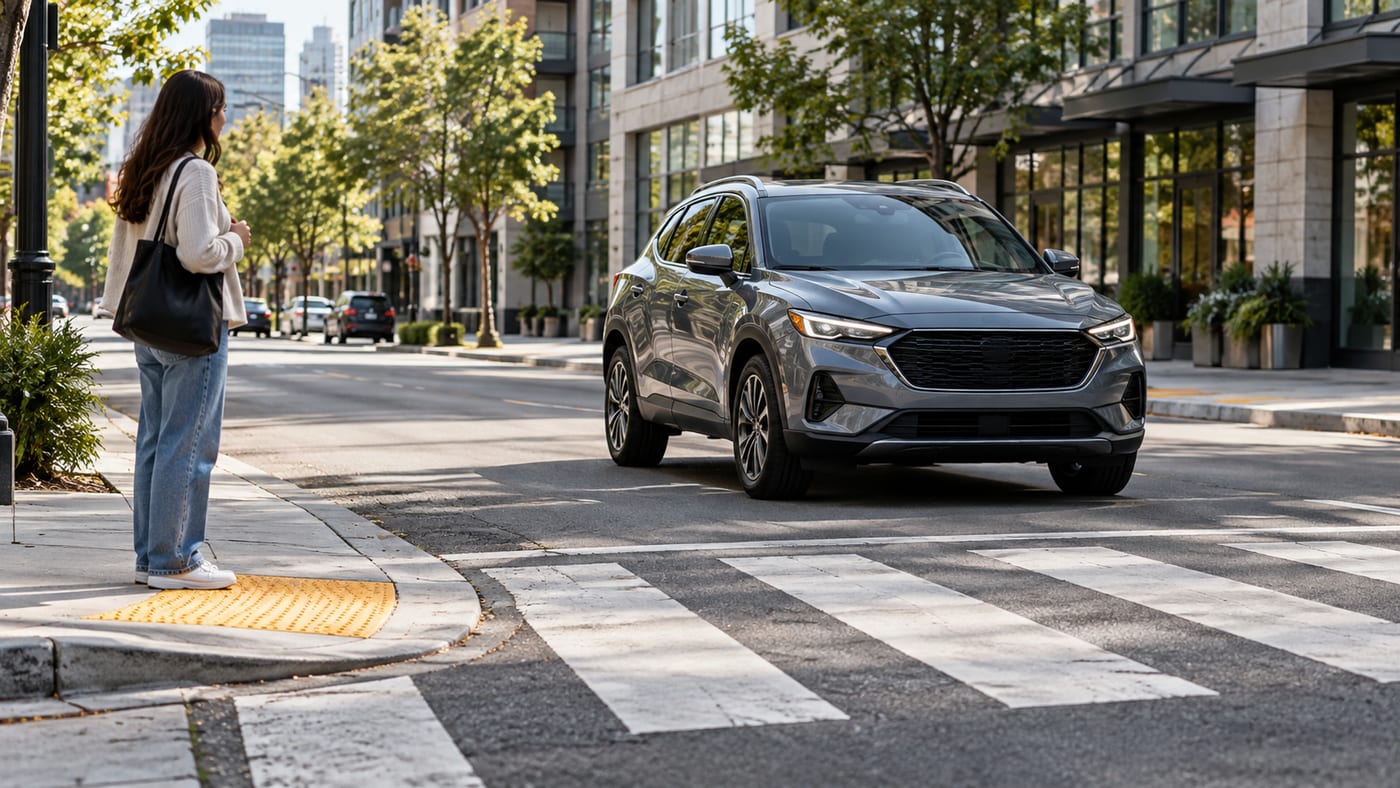
Pedestrian protection now has its own visible place in the U.S. New Car Assessment Program. The National Highway Traffic Safety Administration released the first results for model year 2027 vehicles on September 18. In this initial round, 102 models from 10 manufacturers met the agency’s new performance criteria.
What the new assessment measures
The tests estimate injury risk across several parts of the body. NHTSA describes impacts involving child and adult headforms against the hood and windshield area, an upper-leg impact at the leading edge of the hood, and a lower-limb impact against the bumper. These are controlled assessments of vehicle design. They do not recreate every real-world crash or predict the outcome for a particular pedestrian.
The agency says the ratings pages will mark each model with a yellow box showing whether it passed, failed, has a pending result, or has not submitted a result. That makes the status easier to see when a shopper compares vehicles. The label still needs to be read alongside the rest of the vehicle’s safety information.
How this fits with the 5-Star program
NHTSA’s 5-Star Safety Ratings have long covered crash protection and crash-avoidance technology. The pedestrian assessment adds another view of what happens when a person outside the vehicle is struck. It does not replace frontal, side, or rollover evaluations, and a pass should not be read as a promise that injuries will not occur.
The first set of results is an opening round, not a complete ranking of every vehicle on sale. NHTSA says it expects the new category to encourage attention to pedestrian-friendly vehicle design. The results will be most useful when shoppers compare the exact model year and vehicle they are considering, rather than relying on a brand-wide impression.
What buyers can check
Open the official ratings page for the specific year, make, and model. Check the pedestrian result, then review the separate crashworthiness and crash-avoidance sections. If the page says a result is pending or not submitted, treat that as missing information rather than a pass. Equipment can vary by trim, and the agency’s listing may not answer every question about a particular configuration.
Used-car shoppers can use the same approach, while also checking the vehicle’s history, condition, and any open recalls by VIN. A safety rating describes tested performance under defined conditions. It does not replace a vehicle inspection, maintenance records, or a recall check.
Why the result matters beyond the showroom
Pedestrians share roads with vehicles in cities, suburbs, and rural communities. The geometry of a vehicle’s front end, hood, and bumper can affect how energy is transferred in a collision. The new assessment gives consumers a way to see how selected models perform against a common set of criteria, and gives manufacturers a reason to consider those outcomes during design.
For now, the practical step is straightforward: compare the pedestrian result with the other parts of the rating instead of treating one indicator as a complete safety verdict. Auto Fieldbook’s Auto News coverage tracks further changes to vehicle safety rules and testing.
Leave a Reply