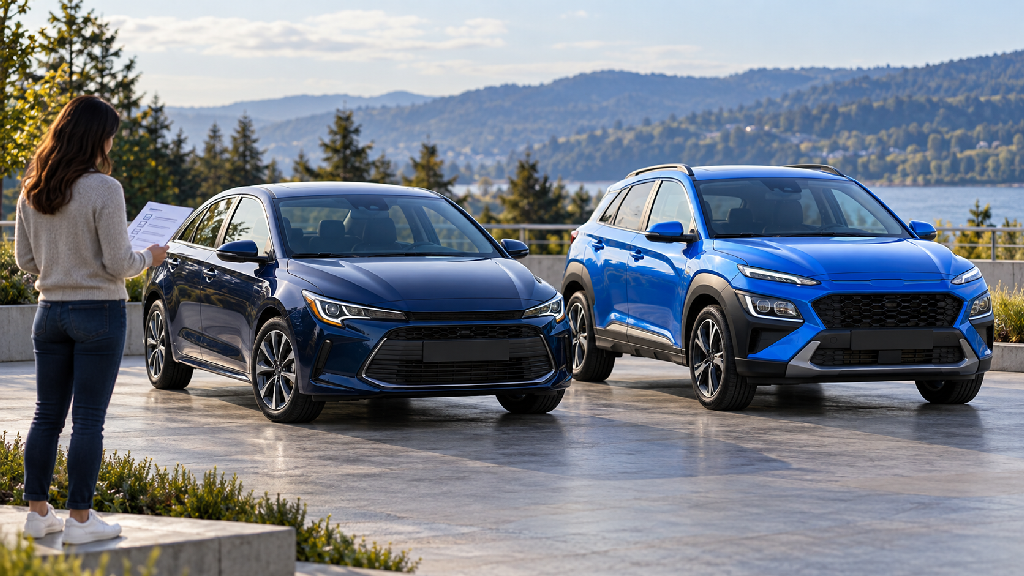
A safety score can make a long vehicle shortlist easier to manage, but a single number cannot answer every question about a car. Ratings refer to particular tests, model years, equipment, and markets. Your decision also depends on the exact version for sale, the people who will ride in it, and how well the vehicle has been maintained.
Use ratings to identify questions and compare relevant vehicles. Then verify the equipment and fit of the car you could actually buy. This guide explains how to do that without treating a star rating as a universal ranking.
Start with the exact vehicle
Record the model year, body style, trim, powertrain, and market for each car on your list. A model name can cover several versions with different engines, restraint systems, headlights, driver-assistance equipment, or production changes. A rating for one version may not apply to every vehicle carrying the same badge.
For a used car, check the production date and vehicle identification number (VIN) when the rating or feature depends on a mid-year change. The Insurance Institute for Highway Safety (IIHS) notes that some awards apply only to vehicles built after a specified date. Its vehicle ratings search can be filtered by year, make, and model. Look for notes attached to the result rather than reading only the award name.
Also confirm the car was built for the market where you will use it. The same name can refer to different specifications in different regions. A vehicle imported from another market may not carry the same safety equipment or may be assessed under a different testing program.
Understand what each rating program measures
In the United States, NHTSA’s New Car Assessment Program uses a 1-to-5-star system for its crash and rollover assessments. NHTSA explains that a high overall score can still carry a separate safety concern marker. Read each test result and notice, not only the overall stars. Its ratings page explains the program and how its comparisons work.
NHTSA cautions that frontal crash ratings should be compared within the same vehicle class and within a specified weight range. Side-impact and rollover results can be compared more broadly under the program’s rules. This matters when a buyer compares vehicles of very different sizes. A simple claim such as “five stars beats four stars” can hide the test category, weight class, or separate warning that produced the result.
IIHS, an independent U.S. research organization, assesses crashworthiness and crash avoidance or mitigation. Its tests include categories beyond a single overall score. Check the individual ratings for the crash tests, headlights, and prevention systems relevant to the model. Testing criteria can change over time, so a result from one year may not use the same protocol as a result from another year.
Outside the United States, look for the consumer testing program or road-safety regulator that covers the car in the market where it was sold. Read the program’s current test descriptions. Ratings from different organizations are not automatically interchangeable because their test methods and scoring systems can differ.
Compare like with like
Build a short table for each candidate. Record the exact model year and production version, rating organization, test year, individual crash results, headlight assessment, and crash-avoidance features tested. Include a note if the score applies to only certain trims or vehicles made after a specified build date.
When two cars have different ratings, open the underlying test details. Find out whether the difference comes from frontal protection, side protection, rollover resistance, headlights, or collision-prevention equipment. Then decide which category is relevant to your use. A family that often drives at night may weigh a headlight assessment differently from a buyer whose main concern is how an adult passenger fits in the rear seat.
Compare vehicles within the test program’s rules. NHTSA says frontal results depend on class and weight, while its side and rollover categories have broader comparison rules. Use the program’s own guidance before treating a score as a direct head-to-head result. When the cars are not comparable under the test, look at the underlying results and your other requirements instead of forcing a single winner.
Verify the equipment on the car for sale
Ask the seller for the equipment list tied to the vehicle identification number or exact trim. Features such as automatic emergency braking, lane-departure warning, blind-spot monitoring, rear cross-traffic alert, and adaptive cruise control may be optional, bundled, or unavailable on some versions. Names also vary between manufacturers. Match the actual function and hardware, not the marketing label.
A safety technology being listed in a brochure does not confirm that it is installed on the specific car. Check the window sticker, manufacturer build sheet, owner’s manual, or equipment display. If a feature uses a camera or radar sensor, ask whether the component has been repaired or recalibrated after windshield, bumper, or body work. Confirm any uncertainty with the manufacturer or a qualified repairer.
Driver-assistance systems can help with particular driving tasks, but they do not take over responsibility for observing the road. Read the owner’s manual for system limits and alerts. During a test drive, learn how the system is activated and what happens when lane markings, weather, or traffic are poor. Do not test it by taking your attention away from driving.
Check whether the car fits its passengers
Safety information is only part of choosing a usable vehicle. Sit in every seat that will be used regularly. Check belt fit, head restraint position, door access, visibility, and room for the required child seats. Bring your own child restraint and follow its manufacturer instructions and local child-passenger law when checking fit. If the car has multiple rows, try the seat in the position where it will actually be installed.
Check that child-seat anchors and tether points are present where expected, then confirm their locations in the vehicle manual. The number and naming of these points vary by market and model. Do not assume that every seat fits every vehicle position. A local inspection service or child-passenger safety specialist may help where available.
Check outward visibility from the driver’s seat and try parking in a safe, familiar setting. Cameras and sensors can help, but they do not make a blocked sightline disappear. A car that feels difficult to place in a lane or parking space during a test drive may be tiring in daily use.
For a used vehicle, check its condition and recall status
A model’s original crash rating describes a tested vehicle in a particular configuration. It does not establish the condition of an individual used car after years of use, repairs, or a collision. Get the car inspected, review maintenance and repair records, and check that airbags and restraint systems have not been removed or improperly repaired.
Search for recalls through the official service for the car’s market. In the United States, NHTSA’s VIN recall lookup shows certain unrepaired recalls, with limitations that include some international vehicles and some newly announced recalls. Check the manufacturer’s local site or national recall database where you live, then ask for evidence of completed repairs.
Our used-car inspection guide explains how to compare vehicle records, arrange an independent mechanical inspection, and review the sale documents. Use those checks alongside the model’s safety results.
A simple comparison worksheet
| What to record | Why it helps |
|---|---|
| Exact year, trim, body style, and market | Confirms that the rating and equipment apply to the vehicle offered. |
| Testing organization and test year | Shows which program and protocol produced the result. |
| Individual crash results and notes | Reveals categories or safety concerns hidden by an overall score. |
| Headlights and crash-avoidance results | Adds information about visibility and tested prevention systems. |
| Features on the exact vehicle | Confirms that the equipment is installed, not merely offered elsewhere in the range. |
| Passenger and child-seat fit | Checks whether the car works for the people who will use it. |
| Inspection and recall records for a used car | Helps distinguish original test performance from current vehicle condition. |
Once you have a few candidates, compare the ratings that genuinely apply to them and note what the test does not cover. Then test the car for fit, confirm its equipment, and check the individual vehicle’s condition. If the score or equipment remains unclear, verify it with the rating organization, manufacturer, or a qualified local professional before you buy.
Leave a Reply